
AI Agents Need Context, Not Just Access. Is Your Enterprise Data Ready to Deliver It?

The race to deploy AI agents is accelerating. But as organisations move beyond experimentation and start connecting AI to real business systems, a fundamental problem is becoming increasingly difficult to ignore.

Giving AI access to enterprise data is relatively straightforward. Giving it access to the right information, with the right context and controls, is something else entirely.
And that's where many organisations are discovering that their biggest AI challenge isn't actually AI. It's their data.
The conversation is changing
Recent developments across the technology industry suggest a significant shift in priorities.
On 6 November 2026, Box CEO Aaron Levie highlighted the importance of unstructured enterprise information in providing AI agents with the context they need to operate effectively. Documents, contracts, research, financial records and other business content contain much of the knowledge agents need to make informed decisions.
On 10 November 2026, Commvault announced a collaboration with NVIDIA aimed at making enterprise information more accessible to AI applications while maintaining governance and security.
Meanwhile, cybersecurity companies are introducing increasingly sophisticated controls over what AI agents can access and the actions they can perform.
The message is becoming clear: successful enterprise AI requires more than powerful models. It requires a reliable understanding of the information those models use.
The problem hiding inside enterprise data
Consider a large organisation operating across multiple departments, locations and technology platforms.
Customer records sit in databases. Contracts are stored in document management systems. Financial information is spread across applications and spreadsheets. Years of emails, shared files and legacy records remain scattered throughout the organisation.
Some information is duplicated. Some is outdated. Some contains sensitive personal or commercial details. And much of it may be poorly classified or difficult to locate.
For employees, these challenges already create inefficiency and risk.
For AI agents, which may search, retrieve and act on information at speed, the consequences can be considerably more significant.
An agent might retrieve an outdated contract rather than its current replacement, encounter confidential information outside its intended purpose, or base a recommendation on incomplete information.
The problem isn't necessarily that the AI system has malfunctioned. It may simply be working with information the organisation itself doesn't fully understand.
Access without understanding isn't enough
Traditionally, enterprise data projects have focused on making information available through integration, migration or consolidation.
But AI introduces a different requirement.
It's no longer enough to know that information exists or that a system can connect to it.
Organisations increasingly need to understand:
What information they hold, and where it resides.
Which records are relevant, current or potentially redundant.
Where sensitive, personal or commercially confidential information exists.
Who is permitted to access particular information.
How information across different systems relates to a business question.
This understanding provides the foundation for delivering relevant, appropriately governed information to AI applications.
It also helps organisations identify and address data problems before those problems are amplified through automation.
Why moving everything into one place isn't the answer
One approach to enterprise AI readiness is to consolidate information into a central repository.
For some organisations and use cases, this may be appropriate. But moving or duplicating vast quantities of information can introduce additional storage costs, operational complexity, security considerations and data residency challenges.
It also doesn't automatically resolve poor classification, inconsistent permissions or outdated records.
An alternative is to build an understanding of the existing data estate while leaving original information where it already resides.
This is where DataBelt takes a different approach.

DataBelt: understanding your data without moving it
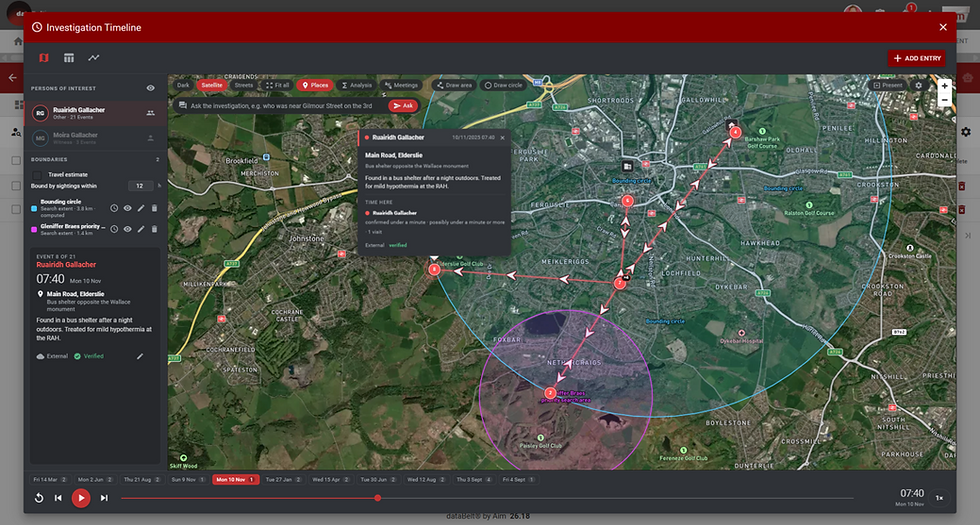
DataBelt is a comprehensive enterprise data platform designed to discover, index, classify, search and govern structured, semi-structured and unstructured information across complex environments.
Using its zero-move architecture, DataBelt connects to existing data sources in read-only mode and creates a separate searchable index, typically just 1-2% of the original data volume.
The source information remains in its existing systems.
This enables organisations to develop a connected view of their information without undertaking a wholesale migration or creating unnecessary copies of the original data.
Through its indexing, classification and search capabilities, DataBelt helps organisations identify relevant information, locate sensitive content, understand their data estate and make better-informed decisions about how information should be used.
Role-based access controls help govern what different users can see and investigate, while flexible deployment options support organisations with specific security and data residency requirements.
For businesses preparing to introduce AI agents, these capabilities provide an important foundation: greater visibility, better classification and a clearer understanding of the information available to support intelligent applications.
DataBelt doesn't replace the need for appropriate AI-specific security controls, but it helps address a critical challenge that comes before them - understanding the enterprise data those systems may rely upon.
The next competitive advantage may be knowing what you already have
As AI technology becomes more accessible, the difference between successful and unsuccessful implementations may increasingly depend on the quality, relevance and governance of the information behind them.
Organisations that understand their data can make better decisions about what to expose to AI, what to protect, what to retain and what to remove.
Those that don't may find themselves investing heavily in increasingly sophisticated technology without addressing the underlying information challenges.
Before asking what AI can do with your enterprise data, perhaps the more important question is: how well do you understand that data in the first place?
Because the future of enterprise AI won't simply depend on connecting more systems.
It will depend on making the information within them understandable, relevant and appropriately controlled.
Discover what your data can do
DataBelt helps organisations discover, understand, govern and make better use of their enterprise information - without moving or duplicating original source data.

Comments