
From Data to Decisions: How DataBelt Solves the Challenges Highlighted in the NPCC Problem Book 2025

The NPCC Policing Problem Book 2025 highlights a number of critical challenges facing UK policing, from managing ever-growing volumes of digital evidence and tackling increasingly complex investigations to improving collaboration, efficiency and decision-making. Whilst each challenge is unique, many stem from a common issue: officers and investigators are often forced to work across multiple disconnected systems, manually piecing together information from vast quantities of data.
Technology alone is not the answer. The real opportunity lies in turning data into actionable intelligence.
A Different Approach to Investigations
DataBelt's Investigation Module has been designed specifically to help investigators rapidly understand complex cases by bringing together information from virtually any source. Whether the data originates from crime recording systems, intelligence platforms, digital evidence repositories, emails, documents, phone downloads, CCTV metadata or partner organisation systems, DataBelt creates a single investigative view.
Once information is ingested, AI-powered analysis automatically extracts key entities, relationships and events. This includes identifying persons of interest, locations, organisations, vehicles, phone numbers, email addresses and other intelligence markers that may be buried within thousands of pages of reports, witness statements or digital evidence.
Rather than investigators manually searching through documents, the platform highlights important connections and presents them in a way that is immediately actionable.
Building the Story of an Investigation
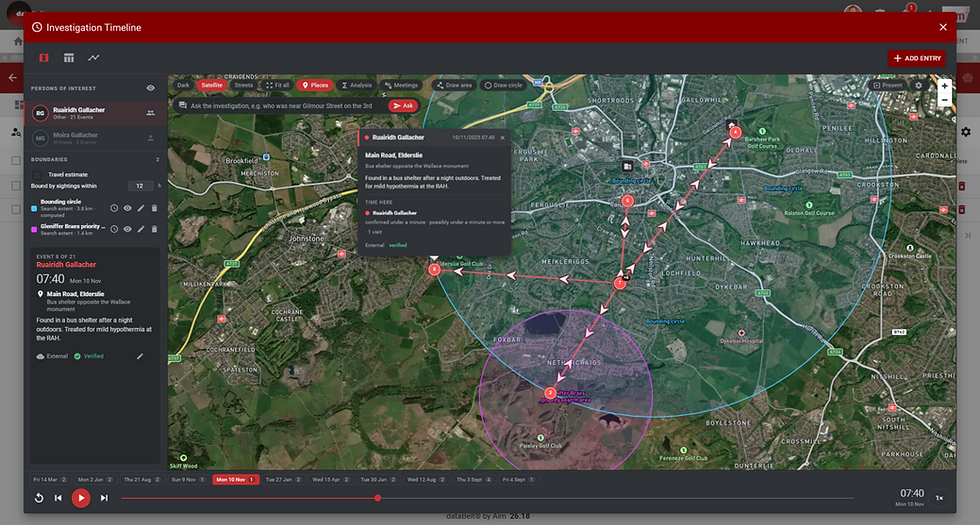
One of the biggest challenges identified by the NPCC is managing increasing volumes of digital information while maintaining investigative effectiveness. DataBelt addresses this by automatically constructing rich visualisations that help investigators understand what happened, when it happened and who was involved.
Investigators can generate:
Interactive timelines showing key events and activities.
Geographic map views displaying incident and intelligence locations.
Direction-of-travel analysis for vehicles, devices or individuals.
Relationship mapping between suspects, victims, witnesses and associates.
Meeting-point and co-location analysis to identify potential connections.
These visual tools allow investigators to move from isolated pieces of information to a complete operational picture far more quickly than traditional investigative methods.
AI-Assisted Lines of Enquiry
As investigations become increasingly complex, identifying the next logical step can be challenging. DataBelt's AI capabilities support investigators by analysing available information and suggesting potential lines of enquiry that may warrant further examination.
For example, the platform may identify recurring contact patterns, unexplored relationships, unexplained gaps in timelines, common locations visited by multiple subjects, or other indicators that could support further investigative activity.
Importantly, these suggestions are presented as intelligence-led prompts for investigator review, helping teams uncover opportunities that may otherwise be missed while maintaining human oversight and operational decision-making.
Supporting the Future of Policing
The NPCC's vision recognises that modern policing requires better use of technology, data and automation to manage growing demand. DataBelt supports this vision by acting as a force-wide intelligence and investigation platform, connecting disparate information sources and transforming raw data into meaningful insight.
By combining data integration, AI-driven entity extraction, visual investigation tools and intelligent enquiry support, DataBelt helps investigators spend less time finding information and more time acting on it.
In a world where investigations increasingly depend on the ability to interpret complex digital data, the challenge is no longer collecting information. The challenge is understanding it. DataBelt helps police forces do exactly that.
Reach out to discover how DataBelt can tackle your policing challenges.


Comments