
AI Agents Are Coming for Your Data. Do You Know What They'll Find?

As organisations race to adopt autonomous AI, a new challenge is emerging: understanding exactly what information these systems can access, whether it can be trusted, and how it is controlled.
AI is moving faster than organisations can govern it
Artificial intelligence is entering a new phase. Businesses are moving beyond chatbots and AI assistants towards autonomous AI agents capable of retrieving information, analysing documents, making recommendations and carrying out tasks across multiple systems.
The opportunities are enormous. But so are the risks.
New research published by IBM in October 2026 revealed that 80% of surveyed executives across Europe and the Middle East had experienced an AI-related incident serious enough to reach their board or C-suite during the previous year. Yet only 40% reported changing their AI governance policies or frameworks in response.
Meanwhile, Gartner's latest AI Hype Cycle highlights a significant shift in priorities. The conversation is moving away from what AI can do towards how organisations can control it, measure its value and ensure accountability.
For businesses, this raises an uncomfortable question:
If an AI agent can access your organisation's information, how confident are you about what it might find?
The hidden problem: data that nobody fully understands
Most organisations have accumulated enormous quantities of information over many years.
Customer records, contracts, financial information, emails, spreadsheets, technical documentation, archived correspondence, images and legacy systems all form part of the corporate data estate.
Some information is structured and carefully maintained. Much of it isn't.
Documents may be duplicated across departments. Sensitive information may be stored in unexpected locations. Historical records may have little or no classification. Different versions of the same information may contradict each other.
For years, these problems have been inconvenient, expensive and occasionally risky.
With AI agents increasingly able to search, interpret and act upon information, they become significantly more important.
An AI system might retrieve an outdated contract, rely on inaccurate customer information or encounter confidential material that should never have been made available to it.
The problem isn't necessarily the AI itself. It's the information being made available to it.
Unstructured data: the biggest opportunity and one of the biggest risks
This challenge is attracting attention beyond the technology industry.
In its 2026 guidance on making government datasets ready for AI, the UK government highlighted the particular difficulties associated with unstructured information, legacy systems and inconsistent data management.
Consider the information held by a typical large organisation. Much of its operational knowledge isn't contained in databases. It lives in documents, correspondence, presentations, scanned records and countless other formats.
This information can be extremely valuable, particularly when AI makes it possible to search and interpret it at scale.
But unlocking that value requires organisations to know what they hold, where it is, how it relates to other information and whether it can be safely used.
Without that understanding, AI adoption risks exposing existing weaknesses rather than resolving them.
From data discovery to data control
This is where the focus needs to change.
Rather than concentrating exclusively on deploying new AI tools, organisations need to establish a comprehensive understanding of the information those tools depend upon.
That means being able to:
Discover information across departments, systems, locations and technologies
Identify and classify structured, semi-structured and unstructured data
Locate sensitive, duplicated, obsolete or potentially inaccurate information
Understand relationships between different information assets
Apply appropriate governance, security and access controls
Make trusted information available for investigation, analysis and AI-driven processes
Crucially, this shouldn't require every organisation to replace its existing systems or move all its data into one central repository.
The objective is to create visibility and control across the existing data environment.

Where DataBelt fits
DataBelt is designed to address precisely these challenges.
As a comprehensive data platform, DataBelt enables organisations to discover, understand, govern, protect and unlock the value of their information, regardless of its type or location.
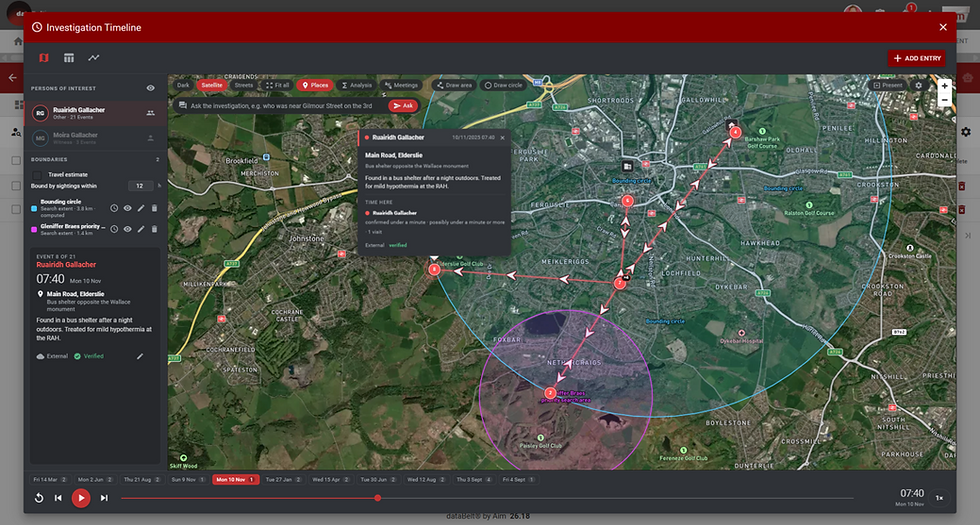
It can identify, index, classify and search information across complex environments, helping organisations gain a connected view of their data estate.
Its capabilities extend beyond conventional data governance to support investigations, regulatory compliance, data quality, legacy information management, security and AI readiness.
For organisations introducing AI agents, this provides an important foundation: greater visibility into the information available, the ability to identify potential data risks and a more controlled approach to preparing information for AI use.
DataBelt can also work alongside other technologies and AI tools, enabling organisations to build upon their existing investments rather than starting again.
Importantly, effective data management isn't just about restricting access. It's about making the right information accessible to the right people and systems, for the right purposes.
The next competitive advantage may not be AI itself
As AI technologies become increasingly accessible, competitive advantage may depend less on which models organisations deploy and more on the quality, accessibility and reliability of the information supporting them.
Businesses that understand their data will be better positioned to automate processes, improve decision-making, reduce operational costs and introduce new AI capabilities with confidence.
Those that don't may find themselves investing heavily in sophisticated technology without fully understanding the information it is using.
The next question for business leaders shouldn't simply be, "What can AI do for us?"
It should be, "Do we understand our data well enough to trust what AI does with it?"
Discover how DataBelt helps organisations take control of their data, whatever its type, location or use case.


Comments